

When travelling through Portugal, you will most likely notice public buildings, churches, monuments and even houses covered with ceramic tiles. Over time, these tiles have become one of Portugal’s most recognisable symbols under the name of Azulejos.
2600 BC, the first ceramic tiles in Mesopotamia.
The earliest known glazed tiles (2600 BC) were discovered in Egypt and Mesopotamia. They then disappeared for centuries before the production techniques re-emerged in 9th-century Iraq and spread throughout the Arab world from Constantinople to Spain.

From the 15th century onwards, ceramic tiles began decorating some of Europe’s most beautiful buildings, from Spain to the Netherlands through Italy and France.
16th century, the first azulejos in Portugal.
At the beginning of the 16th century, King Manuel I imported the first Azulejos from Spain to decorate the walls of the palace he was rebuilding in Sintra. These are the earliest azulejos known in Portugal, although they were made in Spain.

Later, at the end of the 17th century, the Dutch began reproducing Chinese porcelain and developed ceramic tiles dominated by blue and white tones.
The Portuguese then commissioned Azulejos from Dutch workshops for their palaces and churches. In Lisbon, at the Madre de Deus Convent (Igreja do Convento da Madre de Deus), there is a magnificent azulejo panel painted in the Netherlands by Jan van Oort and installed in 1698.

Igreja do Convento da Madre de Deus Lisbon - Unknown credit
18th century, the Portuguese become masters of Azulejos.
At the end of the 18th century, after the Lisbon earthquake of 1755, the Portuguese decided to use azulejos to rebuild the façades of their capital.
This choice was driven by the low production cost of ceramic tiles and their ability to protect buildings from heat and humidity. Azulejo art then reached its peak, and azulejo painters became so highly skilled that they began signing their creations.

Viuva Lamego Factory, Largo do Intendente Workshop
Do not be mistaken: in souvenir shops, you will most often find industrial ceramic tiles simply screen-printed in series. At the other end of the spectrum, antique dealers may offer authentic 17th- or 18th-century azulejos, but their origin is often uncertain because Portuguese law protects azulejos displayed in public spaces and prohibits their commercial trade.
Azulejo panels are, however, still produced by a few rare Portuguese artisans who are often busy restoring historic monuments. You can discover them online by clicking on the image below.

The most beautiful Portuguese azulejos.
The Church of Válega
This church is located in Ovar, near Aveiro. Built in 1746, construction work ultimately lasted more than a century. Today it is nicknamed the “Portuguese Sistine Chapel”. Its azulejos depicting scenes from the Bible are considered masterpieces of Baroque art.

Igreja Matriz de Santa Maria, Válega - Credit: Wikimedia
The Coat of Arms Room at Sintra National Palace
Originally the residence of the Moorish governor during Arab rule in the 10th century, Sintra National Palace was later inhabited by Portuguese kings for nearly eight centuries.
The palace walls were covered with Azulejos very early on, although most have disappeared. The famous Coat of Arms Room, however, is decorated with 18th-century azulejo panels.

Coat of Arms Room at Sintra National Palace
Saint Lawrence Church of Almancil in Faro
In Faro, Saint Lawrence Church of Almancil, built in the 17th century, is dedicated to Saint Lawrence. This Baroque church is entirely covered inside with azulejos illustrating key moments from the saint’s life.
 Saint Lawrence Church of Almancil - Unknown credit
These unique azulejos were created in Lisbon around 1730 before being installed on the walls and six arches of this church, making it truly unique in the world.
São Bento Station in Porto
São Bento Station, in Porto city centre, is relatively recent and opened in 1896. It takes its name from the former “São Bento de Avé Maria” convent that was demolished to make way for the station.
 Main hall of São Bento Station - Unknown credit
The walls of the main hall are covered with azulejos depicting historical scenes from Portugal and scenes from Portuguese daily life.
Capela das Almas in Porto
Capela das Almas is located in the heart of Porto. Built at the end of the 18th century, its exterior walls were only covered with Azulejos in 1929.

Illustration: Capela das Almas de Santa Catarina
These azulejos, painted by Eduardo Leite, were produced by the Viúva Lamego ceramic factory in Lisbon. Using 15,947 tiles covering 360m², they depict the story of Saint Francis of Assisi and Saint Catherine.
In our online boutique, you can discover faithful reproductions of these figurative azulejos. They are handcrafted by artisans who usually specialise in restoring antique azulejos.
 Illustration: Azulejo Anjo Barroco - Luisa Paixão Collection
The National Azulejo Museum in Lisbon.
If the history of Azulejos fascinates you, then a visit to the National Azulejo Museum is essential.
 Museu Nacional do Azulejo, Lisbon
This museum retraces the history of Portuguese ceramic tiles from the 16th century to the present day. The permanent exhibition allows visitors to admire azulejos from different periods and better understand the evolution of production techniques.
Azulejos, a living art in Portugal.
Even today, azulejos continue to be used throughout Portugal in decoration and contemporary architecture. Lisbon metro stations are covered with them, and even highly modern buildings such as Casa da Música in Porto use them for their decorative qualities.

Thanks to faithful reproductions, it is now possible to enjoy the decorative beauty of Azulejos at home — for example by installing them as azulejo wall murals.
 Azulejos assembled as murals - Luisa Paixão Collection
or simply by arranging them creatively on a wall.

Figurative azulejos - Luisa Paixão Collection
And tomorrow?
Contemporary artists and artisans continue to reinterpret azulejos, bringing them into street art, design, jewellery and kitchens.
 Contemporary Azulejos by Charis Tsevis
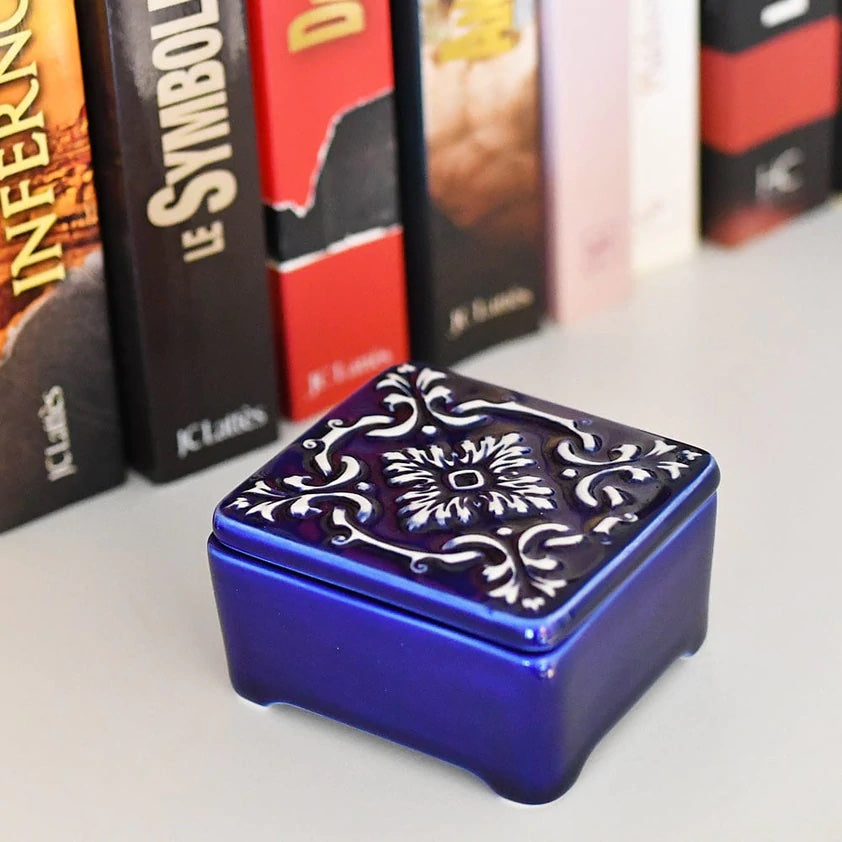 Ceramic azulejo box : Luisa Paixão Collection
Portuguese Azulejos, the Luisa Paixão Collection.