

It often takes only a few seconds to recognise Coimbra ceramics: deep cobalt blue, yellows, greens and ochres painted freehand, foliage, fantastical animals, figures and motifs inspired by historic faience.
But behind this abundance of decoration lies, above all, a remarkable story. The story of a city that has worked with clay for centuries and, from the 16th and 17th centuries onwards, developed one of Portugal’s most distinctive faience traditions.
Even today, a small number of workshops continue to preserve this decorative language. Not by mechanically reproducing historic pieces, but by interpreting them individually, one by one.
That is precisely what inspired us to share this craftsmanship with you.
Coimbra, a city shaped by ceramics
The history of pottery in Coimbra goes back much further than one might imagine. Ceramic production is documented here as early as the Middle Ages, long before faience production truly began to flourish several centuries later.
The city offered particularly favourable conditions: clay-rich soils, water, wood to fuel the kilns and, above all, the Mondego River, an important transport route connecting Coimbra to the Atlantic coast.
The presence of potters even left its mark on the city itself. The names of streets and neighbourhoods still evoke the old workshops and communities of artisans who once worked there.

This geography partly explains why Coimbra became one of Portugal’s great historic centres of ceramic production. The river facilitated the supply of materials, but also the transport of finished pieces to Figueira da Foz and onwards to Atlantic trade routes.
In the 16th and 17th centuries, a distinctive faience emerges
From the 16th century, and particularly during the 17th century, ceramic production became increasingly important in Coimbra. Workshops multiplied, techniques became more sophisticated and the craft itself became more organised.
Being a potter or faience maker was far from an improvised occupation. Apprenticeship was regulated, and mastering the craft required knowledge of clay preparation, shaping, glazing, decoration and, above all, firing – always a decisive stage in the final result.

Gradually, Coimbra developed an aesthetic of its own. Pieces combined glazed faience with richly detailed decoration, often organised around a central motif and extending towards the edges through foliage, arabesques or geometric compositions.
Cobalt blue played an essential role, sometimes used almost exclusively, sometimes combined with yellows, greens, browns and ochres.
These combinations, dense patterns and freedom of composition are what still make Coimbra ceramics so immediately recognisable today.
Ceramics shaped by influences from around the world
Coimbra ceramics did not develop in isolation. Like many of Portugal’s great decorative arts, they were shaped by the commercial and cultural exchanges that passed through the country.
European influences can be seen alongside echoes of ceramics originating much further afield. Local artisans absorbed these influences, transformed them and incorporated them into their own decorative language.

Historic Portuguese faience – 17th century – Courtesy of Museu Quinta das Cruzes
This meeting of influences gave rise to an extraordinarily rich repertoire: flowers, foliage, birds, fantastical animals, human figures, coats of arms, religious scenes and compositions inspired by nature.
A plate was no longer simply a plate. Its entire surface became a space for artistic expression.
The 18th century and the refinement of the great manufactories
By the 18th century, Coimbra was home to several highly regarded workshops. Among them, the Brioso family played an important role in the history of local faience.
Towards the end of the century, another rather unexpected figure appeared: Domingos Vandelli. A naturalist, chemist and professor at the University of Coimbra, he was interested in the industrial applications of science and founded a ceramic manufactory at Rossio de Santa Clara in 1784.
This combination of scientific knowledge, mastery of materials and artisanal tradition helped to further refine local production.

What makes Coimbra ceramics so recognisable
Unlike some Portuguese ceramics whose identity lies primarily in their shape or a particular technique, the personality of Coimbra ceramics is largely defined by their decoration.
It is generous, sometimes almost exuberant. The painter’s hand fills the surface, multiplying the details and leaving very little empty space.

Several characteristics appear time and again:
- cobalt blue, used alone or combined with a palette of yellows, greens, browns and ochres;
- prominent botanical motifs;
- birds and animals, both real and imaginary;
- symmetrical or radiating compositions;
- inspiration drawn from historic 17th- and 18th-century faience;
- and, above all, freehand decoration that gives each piece its own individual character.
This is also what explains its surprising modernity.
A Coimbra piece can be richly decorated yet still find a natural place in a contemporary interior: displayed alone on a console, hung on a wall, used as a centrepiece on a table or combined with much simpler tableware.

From industry to the return of artisan workshops
Like much of European ceramics, production in Coimbra subsequently underwent major changes. During the 19th and 20th centuries, industrialisation profoundly transformed manufacturing methods.
Large companies emerged, including ESTACO, which at its height employed a considerable number of people and helped turn ceramics into a major local industry.

Former ESTACO factory – Courtesy of JV Queiros Photography
By the end of the 20th century, much of this industry had disappeared. Its decline could have taken with it the techniques, motifs and knowledge accumulated over several centuries.
Yet almost the opposite happened.
Today, a tradition that has become precious once again
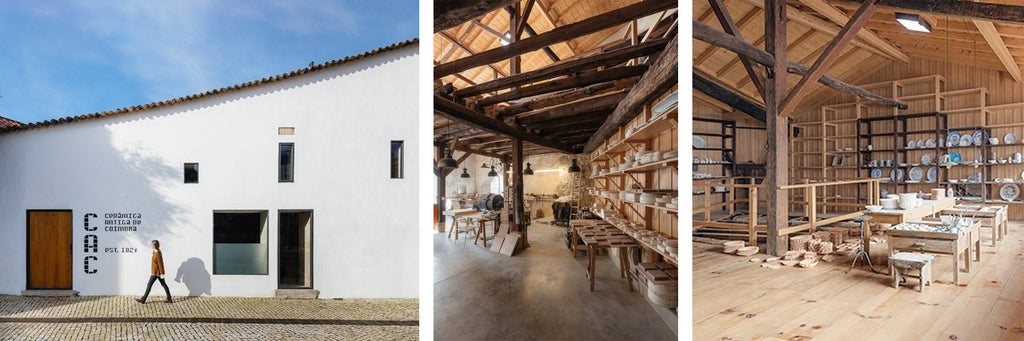
Historic Coimbra pieces are now preserved in museums and private collections. Original examples from the 17th and 18th centuries have become rare and sought after.
But perhaps even more interesting to us is the fact that this story has never completely come to an end.
A small number of artisans continue to work with shapes and decorative motifs inherited from historic collections. They prepare, shape, glaze and decorate their pieces by hand, with all the subtle irregularities and variations this entails.

Why we chose these pieces
At Luisa Paixão, we were not looking for ceramics that were simply inspired by Coimbra. We wanted to rediscover what gives historic pieces their distinctive character: the richness of the decoration, the depth of the colours, the subtle variations of the brush and, above all, that unmistakable sense that a person has worked on each individual object.

We therefore chose to work with a small workshop that continues to produce and decorate its pieces by hand, drawing inspiration from Coimbra’s historic decorative repertoire.
And this is probably what we love most about this collection: the decorators do not follow a printed design down to the last millimetre.
They work from a repertoire of historic motifs while retaining the freedom to interpret them. A leaf may stretch a little further, a bird may adopt a slightly different pose, the density of a pattern may vary, or the blue of a brushstroke may become more intense.
Two pieces of the same design can therefore resemble one another without ever being perfectly identical.
These are not imperfections to be eliminated: they are precisely the traces of how each piece was made.
Bringing a piece of Coimbra into your home
A single plate hung on a wall, a large serving dish placed on a table, an amphora displayed on a console or several pieces brought together as a collection: Coimbra ceramics have enough character to immediately transform the space in which they are displayed.

And behind their colours and patterns, they tell a rarer story: the continuity of a Portuguese craft passed down, transformed and reinterpreted over several centuries.
It is this story that we want to help keep alive today.

Discover the complete Coimbra ceramics collection →
YOUR FIRST ORDER
-10%
Use code OBRIGADO at checkout.
3 comments
Est ce que la collection rayures noir et blanc passe au lave vaisselle svp?
Merci
Bonjour,
Pourriez-vous m’indiquer le volume de votre théière de Coïmbra dont les dimensions sont de 19×16cm ?
Et quel est le délai de livraison pour Paris ?
Merci de votre réponse.
Cordialement
L Pelletier
Bonjour
J’aimerais acheter des assiettes coimbra
Merci pour votre réponse
Cordialement
Durieux